

How to Choose the Right Driveway for Your Colorado Home
November 25, 2026
How to Choose the Right Driveway for Your Colorado Home
November 25, 2026
How to Choose the Right Driveway for Your Colorado Home
A driveway is one of the largest and most visible elements of your property. It provides daily access, supports vehicles, directs drainage, and plays an important role in your home’s curb appeal. Choosing the right driveway requires more than selecting a color or surface—it requires balancing appearance, durability, maintenance, budget, Colorado weather, and the conditions of your property.
Concrete, asphalt, pavers, gravel, and hybrid driveways each provide different advantages. The right choice depends on your home’s architecture, driveway slope, drainage, vehicle use, snow-removal needs, and long-term landscaping plans.
At Alpine Landscaping LLC, we design and build customized Colorado landscapes and hardscapes that coordinate driveways with walkways, retaining walls, drainage, planting, and outdoor lighting. All landscape design and installation work is completed by Alpine Landscaping, providing consistent communication and craftsmanship throughout the project.
Why Your Driveway Material Matters in Colorado
Colorado driveways must withstand demanding conditions, including:
- Repeated freeze-thaw cycles
- Snow and ice
- Intense ultraviolet exposure
- Rapid temperature changes
- Heavy summer storms
- Snowmelt
- Expansive or compacted soils
- Deicing chemicals
- Snowplows and snow blowers
- Mountain and foothill slopes
A driveway that performs well in a mild climate may not provide the same results in Colorado. Material selection is important, but excavation, base preparation, compaction, grading, drainage, reinforcement, and installation quality are equally critical.
The best driveway is one designed around the property rather than selected solely by initial price.
Start With a Complete Site Evaluation
Before choosing a driveway surface, evaluate the entire site.
Important considerations include:
- Driveway length and width
- Number and type of vehicles
- Parking and turning requirements
- Garage elevation
- Connection to the public road
- Slope
- Existing soil
- Drainage patterns
- Roof runoff
- Utility locations
- Snow-storage areas
- Trees and root systems
- Retaining-wall requirements
- HOA standards
- Municipal permits
- Desired appearance
- Available budget
A steep mountain driveway has different requirements than a short, level suburban driveway. A large rural property may benefit from gravel, while a luxury home with an architectural front entrance may be better suited to concrete, pavers, or a custom combination.
Concrete Driveways
Concrete is one of the most familiar residential driveway materials. It creates a clean, durable surface and can complement many architectural styles.
Benefits of a Concrete Driveway
Concrete offers:
- A smooth, stable driving surface
- Clean appearance
- Numerous finishing options
- Compatibility with snow-removal equipment
- Long service life when properly installed
- Lower routine maintenance than loose gravel
- Options for color, texture, and decorative borders
Concrete can be finished with a standard broom texture, exposed aggregate, decorative color, stamped patterns, or paver borders.
Considerations for Colorado
Concrete is rigid, which means movement beneath the slab can contribute to cracking. Colorado’s freeze-thaw cycles make base preparation, drainage, reinforcement, joint placement, concrete specifications, curing, and weather conditions especially important.
Deicing products can also affect concrete surfaces. Homeowners should follow the concrete supplier’s and installer’s recommendations before applying any ice-melting chemicals.
Best For
Concrete may be a strong choice for:
- Traditional or contemporary homes
- Properties needing a smooth surface
- Regular vehicle parking
- Easy snow removal
- Homeowners seeking a clean, understated design
Asphalt Driveways
Asphalt provides a dark, relatively smooth surface and is frequently used for long driveways or larger paved areas.
Benefits of an Asphalt Driveway
Asphalt may offer:
- Lower initial cost than some premium materials
- Fast installation
- A smooth driving surface
- Dark color that can help absorb sunlight
- Easier resurfacing than some rigid materials
- Practical coverage for larger areas
Considerations for Colorado
Asphalt requires periodic maintenance and may need crack filling, sealing, or resurfacing over time. Intense Colorado sunlight, temperature swings, vehicle loads, drainage, and snow-removal methods can affect its performance.
A strong base remains essential. Asphalt installed over inadequate or poorly compacted material can settle, rut, or crack.
Best For
Asphalt may be appropriate for:
- Long driveways
- Large parking areas
- Rural properties
- Homeowners prioritizing function and initial cost
- Properties where a dark, uniform surface fits the design
Paver Driveways
Paver driveways offer one of the most customized and luxurious appearances. Individual concrete pavers are available in many sizes, colors, textures, and patterns.
Benefits of a Paver Driveway
Pavers offer:
- High-end appearance
- Extensive customization
- Contrasting borders and patterns
- Compatibility with paver walkways and patios
- Individual-unit replacement
- Flexibility during limited ground movement
- Strong curb appeal
- Numerous architectural styles
A paver driveway can be designed to coordinate with the home’s exterior stone, front walkway, entry steps, retaining walls, or patio.
Considerations for Colorado
Paver performance depends heavily on:
- Proper excavation
- Compacted aggregate base
- Bedding materials
- Edge restraint
- Joint material
- Drainage
- Paver thickness and rating
- Professional installation
Driveway pavers must be appropriate for vehicular use. Patio-grade products or insufficient base preparation may not withstand repeated vehicle loading.
Snow-removal equipment should be adjusted to avoid catching uneven edges. Joint maintenance may also be required over time.
Best For
Pavers may be the best option for:
- Luxury homes
- Customized entrances
- High-impact curb appeal
- Homes with existing paver features
- Homeowners seeking repairable individual units
- Properties where design is a major priority
Explore Alpine Landscaping’s Colorado landscaping gallery for examples of customized hardscaping and outdoor environments.
Gravel Driveways
Gravel is a practical and attractive option for rural, mountain, and larger Colorado properties. It can provide a natural appearance that blends with surrounding rock, trees, and open land.
Benefits of a Gravel Driveway
Gravel may provide:
- Lower initial material cost
- Natural Colorado appearance
- Good flexibility
- Easier surface replenishment
- Compatibility with long driveways
- Multiple stone colors and sizes
- Less formal visual character
- Potential drainage benefits when designed correctly
A professionally graded gravel driveway can also incorporate berms, crowns, swales, or drainage features to manage runoff.
Considerations for Colorado
Gravel requires ongoing maintenance. Vehicle traffic, snowplowing, storms, and steep grades can move material and create ruts or washouts.
Maintenance may include:
- Regrading
- Adding new material
- Repairing potholes
- Restoring the driveway crown
- Managing weeds
- Correcting washouts
- Cleaning drainage routes
The type, size, angularity, depth, and compaction of the aggregate all affect performance. Simply placing decorative rock over an unprepared surface will not create a dependable driveway.
Best For
Gravel may be a strong choice for:
- Long rural driveways
- Mountain properties
- Natural or rustic homes
- Properties with large access areas
- Homeowners comfortable with periodic maintenance
- Phased property improvements
Permeable Paver Driveways
Permeable pavers are designed with wider joints or openings that allow water to enter a specially prepared base rather than running immediately across the surface.
Benefits of Permeable Pavers
Potential benefits include:
- Reduced surface runoff
- High-end appearance
- Snowmelt infiltration
- Customized patterns
- Integration with drainage planning
- Individual paver replacement
The U.S. Environmental Protection Agency explains that permeable pavement can help rainwater and melting snow infiltrate rather than producing the same volume of surface runoff as conventional impervious paving.
Colorado Considerations
Permeable pavement is not appropriate for every property. Soil infiltration, slope, groundwater, sediment, maintenance, winter conditions, and local regulations must be evaluated.
A permeable driveway may require:
- Specialized pavers
- Open-graded aggregate
- Additional excavation
- Filter or separation materials
- Underdrains
- Edge restraints
- Routine joint maintenance
The system must be designed as a complete pavement and drainage structure.
Hybrid Driveways
A hybrid driveway combines two or more materials to balance budget, appearance, and performance.
Examples include:
- Concrete with a paver border
- Asphalt with a paver entrance apron
- Gravel with a paver parking area
- Concrete driving lanes with decorative stone
- Pavers near the home with gravel farther away
- Gravel with stone edging
- Concrete with a flagstone entry walkway
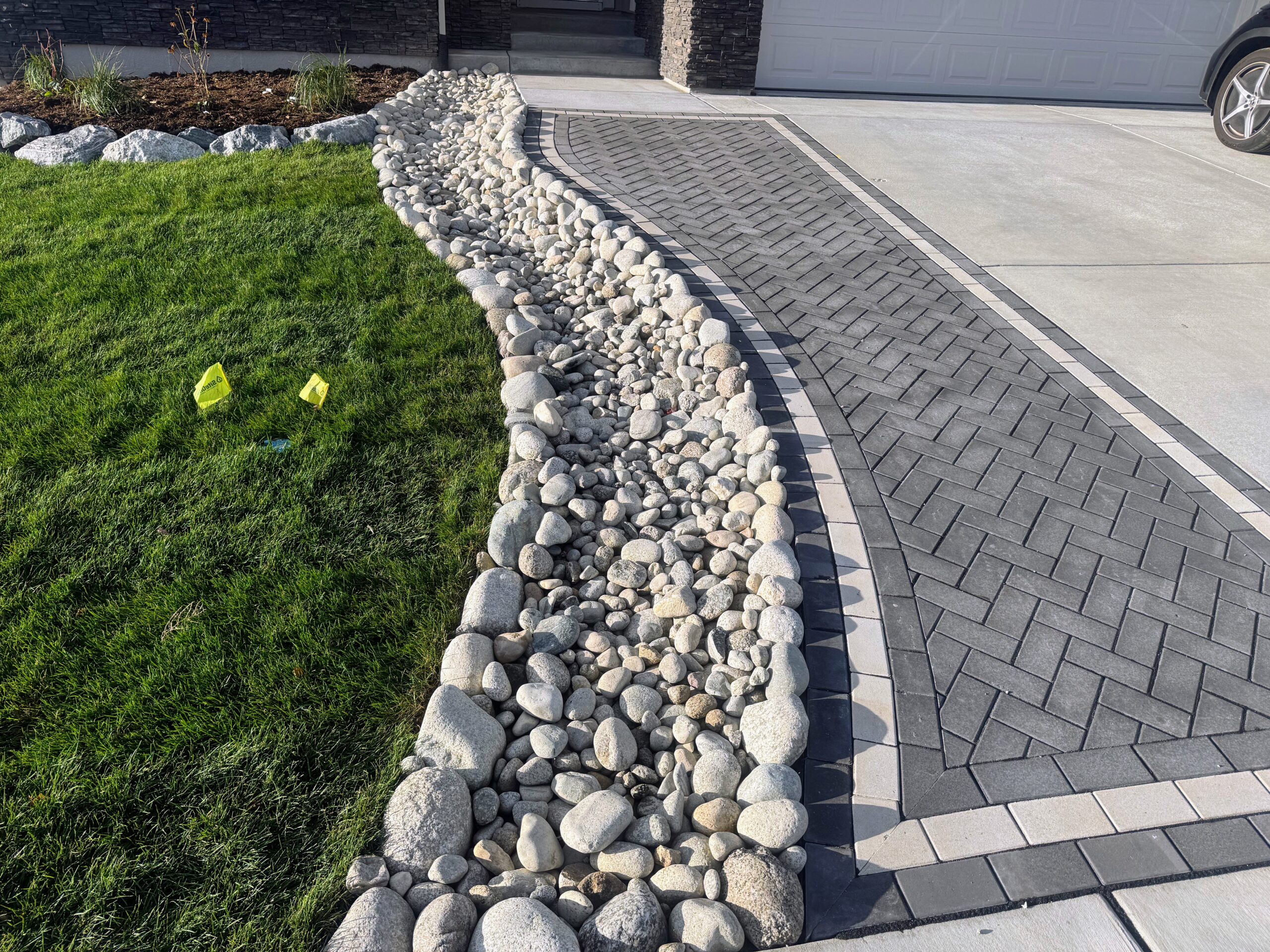
Hybrid designs allow homeowners to invest in premium materials where they create the most impact while using a practical surface for the larger driveway area.
A paver apron at the road or garage can make a basic driveway feel more customized. Matching the border to the home’s walkway or patio can also unify the property.
Driveway Material Comparison
| Driveway type | Appearance | Initial investment | Maintenance | Customization |
|---|---|---|---|---|
| Gravel | Natural and rustic | Lower | Regular regrading and replenishment | Moderate |
| Asphalt | Clean and practical | Low to moderate | Sealing, crack repair and resurfacing | Limited |
| Concrete | Refined and versatile | Moderate | Joint and crack monitoring | Moderate |
| Pavers | Premium and architectural | Higher | Joint care and occasional resetting | Extensive |
| Permeable pavers | Premium and functional | Higher | Joint and infiltration maintenance | Extensive |
| Hybrid | Customized and flexible | Varies | Depends on selected materials | Extensive |
These categories are general. Actual cost and maintenance depend on driveway size, access, slope, demolition, drainage, base preparation, and material availability.
Choose a Driveway That Complements Your Home
The driveway should feel connected to the home and landscape.
Modern Homes
Modern properties often pair well with:
- Large-format pavers
- Smooth concrete
- Dark asphalt with clean edging
- Geometric patterns
- Contrasting paver borders
- Linear landscape lighting
Mountain and Rustic Homes
Mountain-style properties may benefit from:
- Compacted gravel
- Natural stone accents
- Earth-toned pavers
- Boulder edging
- Curved driveway approaches
- Native-inspired planting
Traditional Homes
Traditional architecture often works well with:
- Broom-finished concrete
- Brick-style pavers
- Defined borders
- Symmetrical entry plantings
- Formal walkways
The surface color should complement—not necessarily match—the home’s siding, masonry, roof, and existing hardscaping.
Consider Snow and Ice Removal
Snow removal should influence the driveway design before construction begins.
Consider:
- Will the driveway be shoveled or plowed?
- Where will snow be stored?
- Is there room for equipment to turn?
- Are there raised edges that could catch a plow?
- Will meltwater flow across walking areas?
- Could snow piles block visibility?
- Are valuable plants located near storage areas?
- Will deicing products be used?
A smooth concrete or asphalt surface may be easier to plow, while pavers require proper installation and carefully adjusted equipment. Gravel can be plowed, but the blade may need to remain slightly above the surface to avoid moving significant material.
Snow should not be piled where it will smother shrubs, block drainage, or direct concentrated meltwater toward the home.
Drainage Is Essential
Driveway drainage should be addressed before selecting the final surface.
A driveway can collect and redirect a substantial amount of water. Poor grading may cause runoff to:
- Enter the garage
- Flow toward the foundation
- Cross walkways and freeze
- Wash out gravel
- Erode planting beds
- Saturate retaining walls
- Affect neighboring properties
- Create potholes and settlement
Possible drainage solutions include:
- Proper driveway slope
- Crowning
- Berms
- Swales
- Trench drains
- Catch basins
- Underground pipe
- Culverts
- Permeable pavement
- Dry creek beds
- Retaining-wall drainage
Drainage should be designed around the entire property, not only the driveway surface.
Evaluate the Driveway Slope
Slope affects traction, drainage, snow removal, material stability, and vehicle access.
Steep driveways may require:
- A surface with appropriate traction
- Additional drainage
- Retaining walls
- Erosion control
- Transition zones
- Reinforced edges
- Careful winter maintenance
Loose gravel may migrate downhill on a steep driveway. Smooth decorative finishes may become slippery when covered with snow or ice. The transition between the street, driveway, and garage should also be evaluated so vehicles do not scrape or bottom out.
Do Not Overlook Base Preparation
The finished surface is only as dependable as the construction beneath it.
A driveway base may require:
- Removal of unsuitable soil
- Proper excavation depth
- Geotextile or separation fabric
- Compacted aggregate
- Multiple compacted lifts
- Reinforcement
- Edge restraint
- Drainage
- Accurate grading
The required system depends on the material, soil, vehicle loads, climate, and site conditions.
Reducing the base to lower the installation price may increase the likelihood of settlement, rutting, cracking, and premature repairs.
Think About Maintenance and Long-Term Value
The least expensive driveway to install may not be the least expensive to own.
Consider the long-term costs of:
- Sealing
- Crack repair
- Regrading
- Joint maintenance
- Material replenishment
- Snow removal
- Stain removal
- Drainage repairs
- Individual-unit replacement
- Resurfacing
Pavers generally require a larger initial investment but allow individual units to be repaired or replaced. Gravel costs less initially but needs periodic maintenance. Concrete may offer a long service life but can be difficult to repair invisibly. Asphalt may be resurfaced but requires ongoing care.
The best value depends on how long you plan to remain in the home and how much maintenance you are comfortable performing.
Coordinate the Driveway With Your Landscaping
A driveway should be part of the complete landscape design.
It may be coordinated with:
- Front walkways
- Entry steps
- Retaining walls
- Boulder features
- Planting beds
- Irrigation
- Drainage
- Outdoor lighting
- Parking extensions
- Decorative edging
- Address monuments
Plants can soften a wide driveway, while boulders and walls can define the entrance. Lighting can improve visibility without making the driveway feel like a commercial parking area.
Visit Alpine Landscaping’s complete landscaping services to explore ways to integrate hardscaping, planting, irrigation, lighting, and drainage.
Plan Irrigation Around the Driveway
Irrigation should be designed to avoid overspray onto the driveway. Repeated water can create mineral deposits, ice, staining, and unnecessary waste.
When a driveway is installed or expanded, existing irrigation may need to be:
- Relocated
- Capped
- Rerouted
- Converted to drip
- Reconfigured into new zones
- Adjusted for new planting beds
Learn more about Alpine Landscaping’s Colorado Springs irrigation services.
Add Driveway Lighting
Customized lighting can make a long or curved driveway easier to navigate while improving nighttime curb appeal.
Options include:
- Low-level path lights
- Entry-column lights
- Downlighting
- Address lighting
- Tree uplighting
- Fixtures near parking areas
- Lighting at grade changes
Fixtures should be positioned to reduce glare for drivers, neighbors, and pedestrians.
Explore Alpine Landscaping’s outdoor lighting services.
Check HOA and Municipal Requirements
Driveway construction, replacement, widening, and material changes may require approval.
An HOA may regulate:
- Driveway width
- Surface material
- Color
- Borders
- Parking extensions
- Location
- Drainage
- Lighting
- Construction access
The Colorado Division of Real Estate’s HOA Information and Resource Center provides general information about homeowners’ rights and responsibilities in Colorado common-interest communities.
Municipal or county requirements may also apply to curb cuts, driveway aprons, drainage, right-of-way work, setbacks, culverts, and access to public roads.
Obtain required written approvals before beginning construction. HOA approval does not necessarily replace permits or governmental review.
Which Driveway Is Best for Your Colorado Home?
A gravel option may fit if you want:
- A natural appearance
- Lower initial cost
- A practical surface for a long driveway
- Flexibility and easy material replenishment
Asphalt works well if you want:
- A smooth, practical surface
- Lower initial cost than many premium options
- Efficient coverage for a large area
- A surface that can be resurfaced
Concrete is the best option if you want:
- A clean and refined appearance
- A stable surface
- Easy snow removal
- Several decorative finish options
Pavers will be your choice if you want:
- Luxury curb appeal
- Extensive customization
- Coordinated borders and patterns
- Individual-unit repairability
Permeable pavers will be best if you want:
- A premium appearance
- An integrated runoff-management option
- A specialized system suited to the property’s conditions
Choose a hybrid driveway if you want:
- Premium materials in high-visibility areas
- Practical coverage for a larger space
- A balance between budget and customization
Why Choose Alpine Landscaping?
Alpine Landscaping LLC takes a complete-property approach to driveway and hardscape design.
Our projects may incorporate:
- Paver surfaces and borders
- Gravel driveway improvements
- Driveway extensions
- Entry aprons
- Walkways
- Retaining walls
- Boulder installation
- Grading
- Drainage
- Planting
- Irrigation
- Landscape lighting
All landscape design and installation work is completed by Alpine Landscaping with an emphasis on craftsmanship, drainage, durability, Colorado climate performance, and long-term value.
Create a Driveway That Complements Your Entire Property
The right driveway should support daily use, manage water, withstand Colorado’s climate, and complement your home for years to come.
Concrete, asphalt, pavers, gravel, permeable systems, and hybrid designs each offer advantages. The best choice depends on your property, budget, maintenance preferences, and desired appearance.
Contact Alpine Landscaping LLC to discuss a customized driveway, hardscape, drainage, or complete landscaping project for your Colorado home.
Frequently Asked Questions
What is the best driveway material for Colorado?
There is no single best material for every property. Concrete, asphalt, pavers, and gravel can all perform well when matched to the site and installed over an appropriate base.
Which driveway material handles snow removal best?
Smooth concrete and asphalt are generally straightforward to plow. Pavers can also be plowed when installed correctly and maintained evenly. Gravel requires more careful blade adjustment.
Are paver driveways suitable for Colorado winters?
Yes. Vehicular-rated pavers installed over a properly designed and compacted base can perform well through freeze-thaw cycles. Drainage, edging, and joint maintenance are important.
Is gravel a good choice for a steep driveway?
Gravel can work on some slopes, but steep grades may experience rutting, washouts, and downhill material migration. Site-specific grading, drainage, and aggregate selection are essential.
Do I need HOA approval to replace my driveway?
Many HOAs require approval for changes to driveway materials, colors, dimensions, or parking areas. Review current governing documents and obtain written approval when required.
Does a driveway project require a permit?
Requirements vary by jurisdiction and project scope. Widening, adding a curb cut, modifying the public apron, changing drainage, or connecting to a public road may require approval.
Can driveway construction be completed during winter?
Some driveway and base work may be possible during winter, but frozen soil, snow, temperature requirements, and material specifications can affect installation. Concrete and asphalt generally have more temperature-sensitive placement requirements.