

Landscape Lighting in Colorado: Add Luxury, Safety and Lasting Value to Your Outdoor Space
November 11, 2026
Landscape Lighting in Colorado: Add Luxury, Safety and Lasting Value to Your Outdoor Space
November 11, 2026
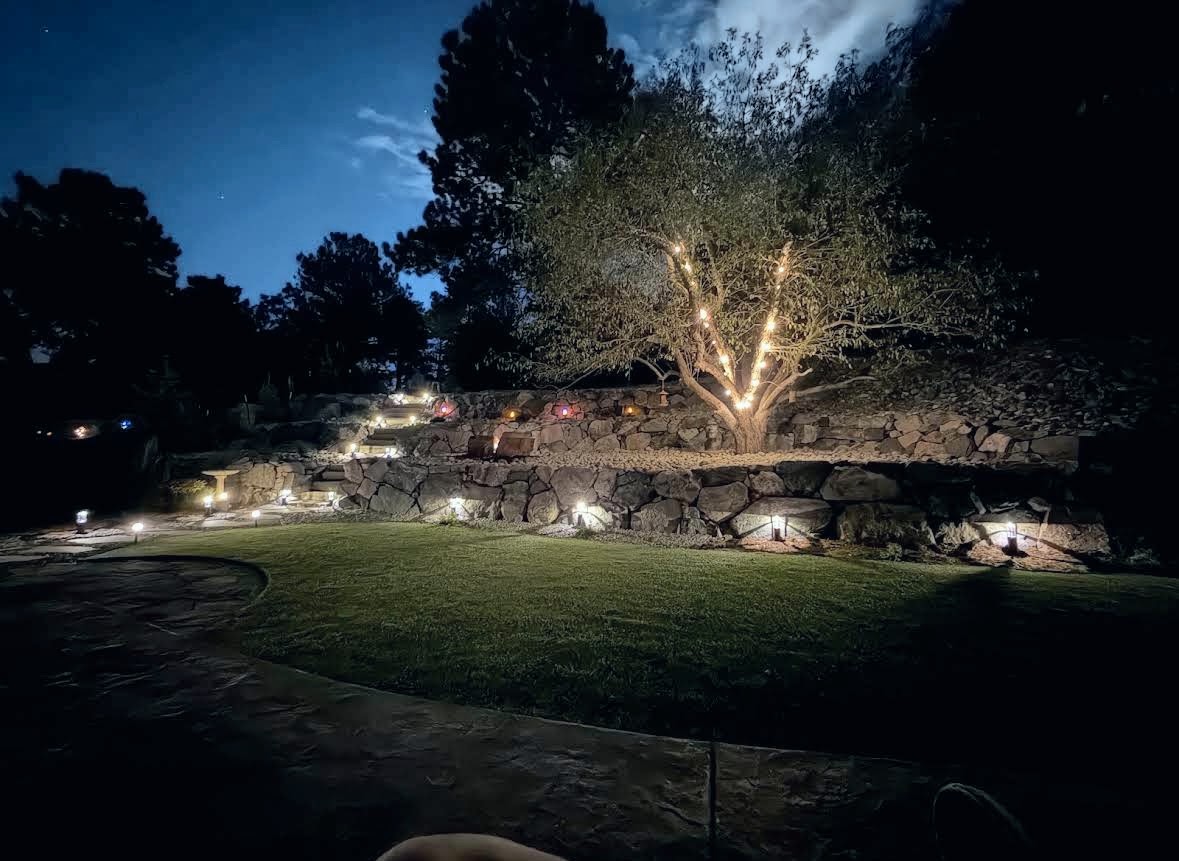
Landscape Lighting in Colorado: Add Luxury, Safety and Lasting Value to Your Outdoor Space
A professionally designed landscape should not disappear when the sun goes down. Adding customized landscape lighting can transform patios, walkways, retaining walls, trees, outdoor kitchens, and water features into an elegant nighttime environment.
The best landscape lighting does more than make a property brighter. It uses carefully placed fixtures to create depth, highlight architectural details, improve visibility, and extend the use of outdoor living areas into the evening.
At Alpine Landscaping LLC, we design and install customized outdoor lighting systems for properties throughout Colorado Springs and surrounding communities. All landscape lighting and related landscaping work is completed by Alpine Landscaping, creating a cohesive experience from the initial design through final installation.
Why Add Lighting to Your Landscaping Project?
Landscape lighting is most effective when it is included in the original landscape design. Planning it alongside patios, walls, planting beds, irrigation, and outdoor living features makes it easier to coordinate fixture locations, conduit, wiring, transformers, and controls.
A customized lighting system can:
- Highlight your home’s architecture
- Improve visibility along walkways and steps
- Extend the use of patios and outdoor kitchens
- Showcase trees, boulders, walls, and water features
- Create a welcoming entrance
- Add depth to the landscape
- Improve curb appeal
- Define outdoor rooms
- Provide year-round visual interest
- Support the property’s long-term value
Learn more about Alpine Landscaping’s outdoor lighting services in Colorado.
Landscape Lighting Creates a Luxury Atmosphere
Luxury lighting is defined by placement and restraint—not by using the greatest number of fixtures.
An effective lighting design creates layers. Some fixtures illuminate circulation areas, while others emphasize plants, stonework, water, or architectural features. The contrast between light and shadow gives the property dimension.
A professionally designed system may combine:
- Path lighting
- Uplighting
- Downlighting
- Step and wall lights
- Ledge lighting
- In-ground fixtures
- Well lights
- Patio lighting
- Outdoor kitchen lighting
- Water-feature lighting
- Architectural accent lighting
When every fixture has a purpose, the landscape feels warm, polished, and intentional.
1. Path Lighting for Walkways and Entrances
Path lights can improve visibility while guiding visitors toward the home, patio, or another outdoor area. They are especially useful along curved walkways, elevation changes, and paths bordered by plants.
Well-designed path lighting should:
- Illuminate the walking surface
- Avoid excessive glare
- Use appropriate fixture spacing
- Coordinate with the home’s architecture
- Remain visible without dominating the landscape
- Avoid creating a repetitive “runway” appearance
Fixtures do not always need to be installed at perfectly equal intervals. Alternating their placement and coordinating them with plants or boulders can produce a more natural effect.
2. Step and Retaining-Wall Lighting
Colorado properties often include slopes, terraces, retaining walls, and outdoor steps. Integrating lights into these structures can improve visibility while adding an architectural detail.
Potential locations include:
- Stair risers
- Beneath wall caps
- Seat walls
- Raised planting beds
- Patio edges
- Outdoor kitchen walls
- Entry landings
Wall and step lights are easiest to integrate while the hardscaping is being constructed. Adding them later may require removing blocks, drilling finished materials, or finding alternate wiring routes.
3. Uplighting Trees and Architectural Features
Uplighting directs light upward from a low fixture to emphasize height, structure, and texture.
It works especially well on:
- Mature trees
- Evergreen trees
- Ornamental trees
- Stone or brick walls
- Columns
- Gables
- Entry features
- Large boulders
- Sculptural plants
Lighting every tree can make the property look flat and overly bright. Selecting a few important specimens generally creates a stronger luxury appearance.
The beam width, fixture distance, brightness, and aiming angle should be matched to the subject being illuminated.
4. Downlighting and Moonlighting
Downlighting places a fixture above the area being illuminated. When installed and aimed properly, it can resemble soft moonlight passing through tree branches.
Downlighting may be used for:
- Patios
- Outdoor dining areas
- Walkways
- Driveways
- Seating areas
- Garden beds
- Recreation areas
Moonlighting can create attractive branch shadows and a more natural atmosphere than bright overhead fixtures. Installation must account for safe access, tree growth, fixture maintenance, and glare.
5. Outdoor Kitchen and Dining Lighting
A custom outdoor kitchen needs both atmosphere and functional task lighting.
Important locations may include:
- Grills
- Preparation counters
- Sinks
- Bar seating
- Cabinet areas
- Dining tables
- Steps and transitions
- Pergola posts
- Walkways leading back to the house
Cooking areas need enough light for safe food preparation, but the rest of the space should still feel comfortable and relaxed.
A layered plan may combine task lighting over the counter with lower-level patio, wall, and landscape lighting around the perimeter.
Explore Alpine Landscaping’s custom outdoor kitchen services.
6. Fire-Pit and Fireplace Lighting
A fire feature produces its own warm light, so nearby fixtures should support it rather than compete with it.
Lighting around a fire area may include:
- Low-level path lights
- Lights beneath seat-wall caps
- Step lights
- Subtle tree uplighting
- Lighting near serving surfaces
- Dimmable fixtures
- Soft perimeter lighting
Bright or cool-colored fixtures can overpower the flame and reduce the cozy atmosphere. Warm, low-level lighting generally complements fire features more successfully.
7. Water-Feature Lighting
Moving water reflects light and can become one of the most dramatic nighttime elements in a landscape.
Lighting can highlight:
- Bubbling boulders
- Pondless waterfalls
- Multi-tier waterfalls
- Streams
- Ponds
- Fountain basins
- Surrounding plants and boulders
Fixture placement should account for water movement, glare, viewing angles, electrical requirements, and winter operation. Underwater or wet-location fixtures must be specifically rated for their intended use.
Learn more about Alpine Landscaping’s custom pondless water features.
8. Lighting for Colorado’s Weather and Climate
Outdoor lighting fixtures in Colorado must withstand more than occasional rain. Depending on the property, they may be exposed to:
- Snow
- Ice
- Hail
- Intense ultraviolet light
- Dry air
- Strong winds
- Freeze-thaw cycles
- Temperature extremes
- Irrigation spray
- Snow-removal equipment
For better longevity, outdoor fixtures, connections, transformers, and wiring should be rated for their installation environment.
Durable materials may include:
- Brass
- Copper
- Powder-coated aluminum
- Quality composite materials
- Stainless components where appropriate
Premium brass and copper fixtures generally cost more initially, but they can offer substantial durability and develop an attractive natural patina. Lower-cost fixtures may still work in selected applications, although finish quality, seals, replaceable components, and warranty coverage should be reviewed.
Why LED Landscape Lighting Is a Strong Choice
LED technology has become the standard for many professional landscape lighting systems because it offers efficiency, controllability, and long service life.
The U.S. Department of Energy reports that quality white LED products may provide approximately 30,000 to 50,000 hours of useful life, with actual longevity affected by product quality, heat management, electrical components, and operating conditions. Review the Department of Energy’s LED lighting guidance for additional information.
Potential benefits of LED landscape lighting include:
- Lower energy use
- Long operating life
- Reduced lamp replacement
- Smaller fixture options
- Dimming capability
- Multiple beam spreads
- Consistent color options
- Compatibility with smart controls
Not every LED product provides the same performance. Color quality, fixture construction, optics, seals, driver quality, warranty, and replaceable components can vary considerably.
Warm Light vs. Cool Light
Color temperature has a significant effect on how a landscape feels.
Warm lighting generally complements:
- Natural stone
- Wood
- Fire features
- Traditional architecture
- Earth-toned pavers
- Flowering plants
- Outdoor dining areas
Cooler lighting may be appropriate for selected modern architectural details, but excessive blue-white light can feel harsh and produce more glare.
DarkSky International recommends using outdoor lighting that is useful, targeted, low-level, controlled, and warm-colored. Its Five Principles for Responsible Outdoor Lighting provide a helpful framework for creating effective illumination while limiting unnecessary light.
For many residential landscapes, warm-white light near 2700K or 3000K creates an inviting appearance. The best color temperature depends on the home, materials, plants, and desired atmosphere.
Low-End Landscape Lighting Options
A focused lighting project can improve an important part of the property without illuminating the entire landscape.
A lower-budget installation may include:
- Several path lights
- Lighting at the front entrance
- One or two tree uplights
- Step lighting
- A transformer and timer
- Lighting around a small patio
Professional lighting projects commonly begin in the low-thousands, depending on fixture quality, access, wiring, transformer requirements, and the number of lights.
How to Maximize a Smaller Lighting Budget
Focus on areas that provide both beauty and function:
- The primary walkway
- Steps or elevation changes
- The front entrance
- One important tree
- A patio or fire feature
- A prominent architectural detail
It is usually better to illuminate a few areas effectively than to spread too many low-quality fixtures across the entire property.
Mid-Range Landscape Lighting Options
A mid-range lighting plan may include multiple areas and several lighting techniques.
Possible features include:
- Front walkway and entrance lighting
- Tree uplighting
- Patio illumination
- Retaining-wall lights
- Fire-pit lighting
- Outdoor kitchen task lighting
- Smart controls
- A larger transformer
- Expansion capacity for future phases
Professional installations in this category may fall around $5,000 to $10,000 or more, depending on the number and quality of fixtures, wiring distances, controls, access, and installation conditions.
These figures are general planning ranges, not estimates. A customized design and site evaluation are necessary for accurate pricing.
High-End Landscape Lighting Options
Large or highly customized properties may require extensive fixture coordination and several lighting zones.
A high-end system may include:
- Layered architectural lighting
- Lighting throughout multiple outdoor rooms
- Premium brass or copper fixtures
- Large-tree uplighting
- Moonlighting
- Wall and step lights
- Water-feature illumination
- Outdoor kitchen lighting
- Pergola lighting
- Dimming
- App-based controls
- Multiple transformers
- Expandable zones
- Customized maintenance planning
Luxury landscape lighting systems can exceed $10,000 and may rise substantially on large properties or designs involving specialty fixtures, complex wiring, extensive hardscaping, or advanced controls.
The goal should remain visual quality rather than fixture quantity.
Low-Voltage vs. Line-Voltage Lighting
Many residential landscape lighting systems use low voltage, often 12 volts. Low-voltage systems are versatile and work well for path lights, uplights, wall fixtures, and many garden applications.
Potential advantages include:
- Smaller fixtures
- Flexible placement
- Energy efficiency
- Easier expansion
- Extensive fixture variety
- Compatibility with modern controls
Line-voltage lighting may be appropriate for certain architectural, security, utility, or high-output applications. Electrical work must comply with applicable codes and should be handled by qualified professionals when required.
A professional design determines which system is appropriate for each part of the property.
Smart Controls and Lighting Zones
Modern landscape lighting can be divided into zones so different areas operate independently.
For example:
- Entrance lights may remain on during evening hours.
- Outdoor kitchen lights may operate only when the space is in use.
- Water-feature lights may follow the feature’s operating schedule.
- Security-related lighting may use motion controls.
- Decorative tree lighting may turn off later at night.
Control options may include:
- Timers
- Astronomical clocks
- Photocells
- Dimmers
- Motion sensors
- Wireless controls
- Smartphone applications
- Smart-home integration
Controls can improve convenience while reducing unnecessary operating time. The Department of Energy notes that exterior lighting controls can produce additional energy and operating-cost savings beyond fixture efficiency alone.
Responsible Lighting and Colorado’s Night Sky
Colorado’s clear skies and natural surroundings are important parts of the outdoor experience. A responsible lighting plan can improve a property without creating excessive glare or sending unnecessary light toward neighboring homes and the sky.
Good practices include:
- Aim fixtures carefully.
- Use shielding where appropriate.
- Select the lowest effective brightness.
- Avoid unnecessary floodlighting.
- Use warm color temperatures.
- Install timers or other controls.
- Keep light within the intended property area.
- Re-aim fixtures as plants grow.
- Review applicable HOA and municipal requirements.
Responsible lighting is especially important on mountain, foothill, rural, and open-space properties where dark skies are part of the setting.
Landscape Lighting and HOA Approval
Some homeowners’ associations regulate outdoor lighting because fixtures are visible from neighboring properties and streets.
An HOA may review:
- Fixture style
- Fixture height
- Brightness
- Color temperature
- Placement
- Light trespass
- Hours of operation
- Architectural compatibility
- Wiring or transformer locations
Before installation, review the association’s current design standards and determine whether written approval is required.
A landscape lighting plan can help communicate fixture locations, quantities, styles, and intended effects. If the approved design changes significantly, additional review may be required.
Does Landscape Lighting Add Property Value?
Professional outdoor lighting may contribute to property value by improving curb appeal, nighttime presentation, functionality, and the perceived quality of the landscape.
Potential value includes:
- More usable outdoor living space
- Improved visibility
- Better nighttime curb appeal
- Highlighted architecture
- Greater enjoyment of patios and kitchens
- A more finished landscape
- Broader appeal to future buyers
The National Association of REALTORS® identifies curb appeal and outdoor improvements as important considerations for many homeowners and buyers in its Remodeling Impact Report: Outdoor Features.
No lighting project can guarantee a specific increase in resale value. The result depends on the quality of the design, installation, maintenance, neighborhood, and local real estate market.
Plan Lighting Before Construction Begins
The ideal time to plan landscape lighting is before patios, walkways, walls, planting beds, and outdoor kitchens are installed.
Early planning makes it possible to:
- Place conduit beneath hardscaping
- Conceal wiring
- Integrate lights into steps and walls
- Coordinate transformers
- Avoid conflicts with irrigation
- Provide electrical capacity
- Plan future expansion
- Position fixtures around mature plant sizes
If lighting is added later, installation may still be possible, but finished surfaces and established landscaping can limit wiring routes.
A complete design helps reduce avoidable demolition and supports a cleaner finished result.
Coordinate Lighting With Plant Growth
Plants change significantly after installation. A shrub that is small during construction may eventually block a path light, while a young tree may need fixture adjustments as its canopy expands.
A professional design should consider:
- Mature plant height and width
- Seasonal foliage
- Future pruning
- Root-zone protection
- Irrigation spray
- Fixture access
- Changes in focal points
- Snow accumulation
Lighting systems should be reviewed periodically so fixtures remain correctly aimed and unobstructed.
Landscape Lighting Maintenance and Longevity
Even premium lighting systems require occasional maintenance.
Typical maintenance may include:
- Cleaning lenses
- Removing mineral buildup
- Straightening fixtures
- Re-aiming lights
- Trimming obstructing plants
- Inspecting exposed wire
- Testing controls
- Checking transformer performance
- Replacing damaged components
- Adjusting schedules seasonally
Snow, frost heaving, landscape maintenance, plant growth, pets, and wildlife can move fixtures over time. Routine service helps preserve both appearance and performance.
Why Choose Alpine Landscaping?
Alpine Landscaping LLC creates customized lighting plans that coordinate with the complete landscape.
Our lighting designs may complement:
- Paver and flagstone patios
- Walkways and steps
- Retaining walls
- Outdoor kitchens
- Fire pits and fireplaces
- Water features
- Trees and planting beds
- Pergolas
- Front entrances
- Boulder installations
- Complete outdoor living spaces
All landscape lighting and related landscaping work is completed by Alpine Landscaping with an emphasis on craftsmanship, durability, thoughtful placement, and long-term value.
View our Colorado landscaping gallery for inspiration from completed outdoor spaces.
Illuminate Your Colorado Landscape
Landscape lighting can transform how your property looks, feels, and functions after sunset. From a few carefully placed walkway lights to a complete luxury system with architectural lighting, illuminated walls, water features, and smart controls, every project should be tailored to the home and landscape.
The most successful lighting plans balance beauty, visibility, energy efficiency, responsible illumination, Colorado weather resistance, and long-term performance.
Contact Alpine Landscaping LLC to begin designing a customized landscape lighting system for your Colorado property.
Frequently Asked Questions
How much does professional landscape lighting cost?
A smaller professional installation may cost approximately $2,000 to $5,000. Mid-range designs may fall between $5,000 and $10,000, while extensive luxury systems can exceed $10,000. Fixture quality, quantities, wiring, transformers, access, controls, and project complexity determine actual pricing.
What is the best color temperature for landscape lighting?
Warm-white light around 2700K to 3000K is popular for residential landscapes because it complements natural stone, wood, plants, and fire features. The best choice depends on the home and desired atmosphere.
Can landscape lighting withstand Colorado winters?
Quality exterior fixtures and properly protected connections can perform well in Colorado. Materials, ratings, installation methods, drainage, snow exposure, and maintenance all affect longevity.
Should lighting be installed before or after landscaping?
Lighting should ideally be designed before construction begins. This allows wiring and conduit to be coordinated with patios, walls, steps, planting beds, and irrigation.
Does landscape lighting use a lot of electricity?
Modern LED systems can be highly energy-efficient. Total use depends on fixture wattage, quantity, brightness, controls, and operating time.
Can landscape lighting be installed in phases?
Yes. A properly sized transformer, planned wiring routes, and a complete lighting design can make future expansion easier.
Does outdoor lighting require HOA approval?
Some HOAs regulate fixture appearance, brightness, placement, and operating hours. Review the current community guidelines and obtain written approval when required.